What was unique about the project with UT Mechanical Engineering Dept. and SMS was:
1. The X-ray CT machine produced a series of 2D slices that when completed was the full 3D scan of the object.
2. As each slice was completed the digital information of the slice was sent to the laser sintering machine via phone modem.
3. The Laser sintering machine produced one slice at a time of the overall object as it was received via phone modem.
4. Information of each slice was sent as vectored outlined polygons.
5. Pixel information was also sent as a 2D images for each slice.
6. Information about the object edges were sent as both exterior and interior surfaces.
7. The laser sintering machine did both exterior surfaces and interior surfaces.
8. The X-ray CT scanning, laser sintering, and communication via phone modem were all automatic.
Once started it did not require human intervention.
The target object that was scanned and reproduced at UT Mechanical Engineering Dept. was a Ford engine piston. It was reproduced in a polycarbonate material, and it took 2 hours to X-ray CT scan the object, send via phone modem, and to reproduce as a 3D object in polycarbonate material. Since all were done at the same time it took only 2 hours. If the piston had 1st been X-ray CT scanned and then sent via modem and then laser sintered it would have taken six hours or more. At the start of the 1st full test of the "World's 1st 3D Fax Machine" a group of scientists came to SMS to view the process. The scientists were at UT for the [1]"Solid Freeform Symposium". What was witnessed was a Ford piston placed inside the X-ray CT scanning chamber. Lead doors were locked and the X-ray CT scanning process was started. The view of the X-ray CT scanning was viewed via 2 video cameras inside the X-ray chamber. When the scanning was about half done the scientists drove from SMS Inc. to University of Texas Mechanical Engineering Dept. about 9 miles away. When the scientists arrived at the laser sintering lab at UT, they witnessed half of a polycarbonate piston being reproduced in 3D. At the end of the test, the completed reproduced piston was taken out of the laser sintering chamber and cleaned. The next day both the reproduced polycarbonate piston and the actual Ford piston were shown together in the same room.
Unlike most other 3D fax machines this one test simultaneously 3D scanned, sent via modem, and produced interior and exterior surfaces of a complex 3D object from one continuous 3D X-ray CT scan. The first successful test was done in August 1991, Austin Texas.
[2] Article from UT OnCampus showing laser sintering machine at UT Mechanical Engineering Dept. in August 12, 1991

[3] Article from Austin American-Statesman showing X-ray CAT scanner at Scientific Measurement Systems Inc. in August 15, 1991
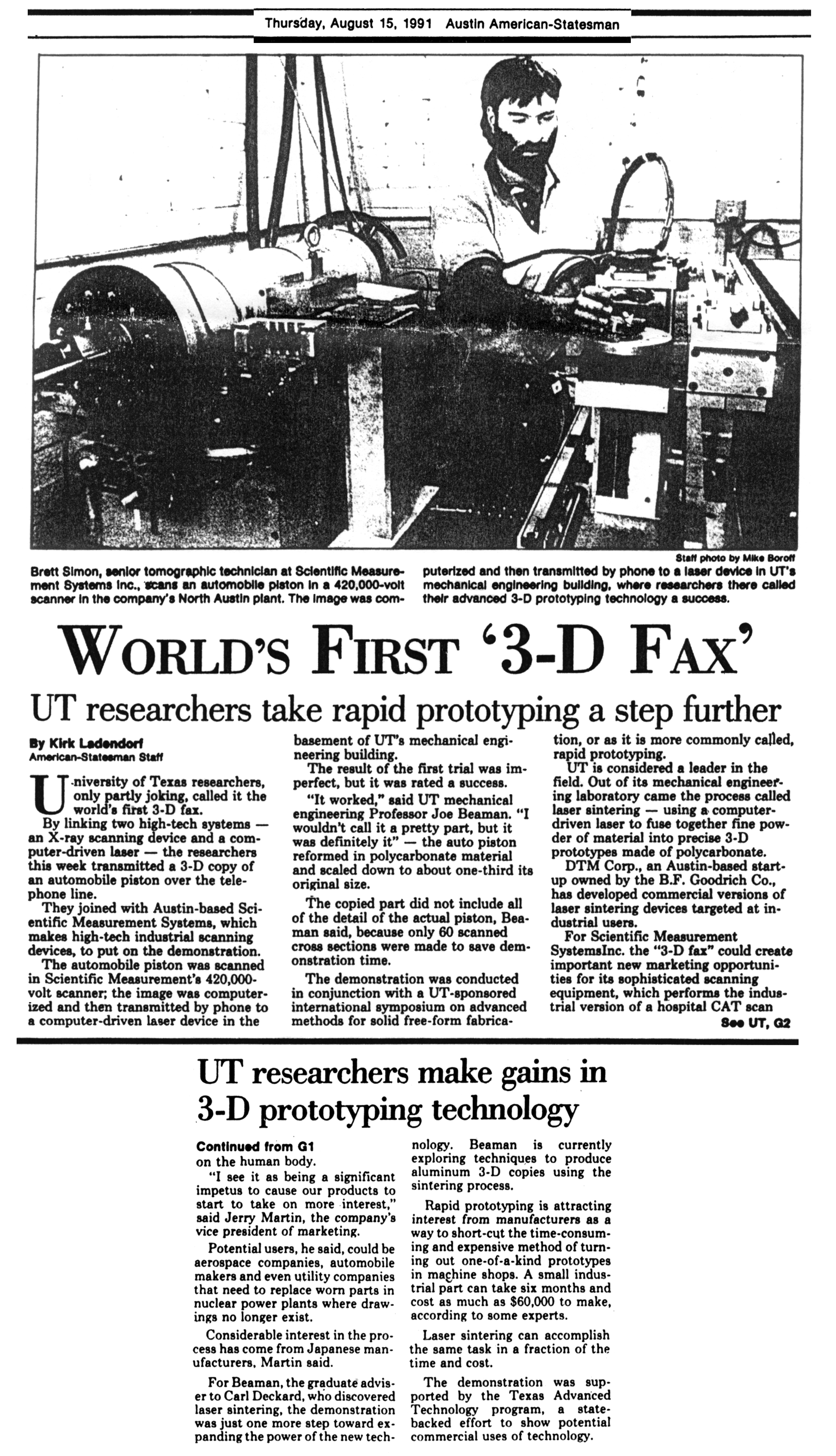
If the text is hard to read click on either news article to view a higher resolution image of article.
[4] Article by Richard H. Crawford and Joseph J. Beaman in IEEE Spectrum
"In fact, a 3-D fax was implemented for the first time in August 1991 in Austin,
Texas, when a part was digitized at Scientific Measurement Systems Inc., an
Austin-based technology company that manufactures high-power X-ray scanning
systems. The data was then sent over telephone lines to the Laboratory for
Freeform Fabrication at The University of Texas, in Austin, where a selective
laser-sintering system was used to recreate the part."
----------------
This document was from a web page that was previously published over time at different web site departments at the University of Texas at Austin. At the same time this web page written by Reuben Reyes was also referenced by 6 research papers. Over time the previously published web pages were removed after Reuben Reyes moved to other University of Texas at Austin departments and eventually he moved to another university. This made the web references in several research papers to the older web pages obsolete. Reuben Reyes at the time had no idea his web page 3D_fax.html would be used as a research paper reference. To try and help fix the older lost obsolete non-existent web locations of this page, a reverse reference is now posted for this section. In this section (reverse reference) below is a list of 6 papers that previously used older web pages written by Reuben Reyes. Included in each section is the name of the paper published and the REFERENCED in capital letters within each numbered paper (1 to 6). Each section is a different paper numbered 1 to 6 that includes the reference to the older web page that no longer exists.
----------------
Paper 1 (chapter) with non-working web address link. This page was previously published at now a defunct web site and page : http://www.tacc.utexas.edu/~reyes/tacc_personal/self/3D_fax.html (Do not link to this URL)
Was REFERENCED by paper: Visualization Handbook by Charles D. Hansen, Chris R. Johnson, Chapter 6 Isosurfaces and Level-Sets by Ross T. Whitaker
----------------
Paper 2 with reference to a non-working web address link. This page was previously published at now a defunct web site and page : http://www.ices.utexas. edu/~reyes/self/3D fax.html (Do not link to this URL)
and was REFERENCED by paper: Sensing and reproducing the shapes of 3D objects using claytronics by Padmanabhan Pillai, Jason Campbell
----------------
Paper 3 with reference to a non-working web address link. This page was previously published at now a defunct web site and page : http://www.ices.utexas.edu/~reyes/self/3D_fax.html (Do not link to this URL)
and was REFERENCED by paper: A 3D Fax Machine based on Claytronics by Padmanabhan Pillai, Jason Campbell, Gautam Kedia, Shishir Moudgal, Kaushik Sheth
----------------
Paper 4 with reference to a non-working web address link. This page was previously published at now a defunct web site and page : https://webspace.utexas.edu/reyesr/self/3D_fax.html (Do not link to this URL)
and was REFERENCED by paper: Scotty: Relocating Physical Objects Across Distances Using Destructive Scanning, Encryption, and 3D Printing by Stefanie Mueller, Martin Fritzsche, Jan Kossmann, Maximilian Schneider, Jonathan Striebel, Patrick Baudisch
----------------
Paper 5 with reference to a non-working web address link. This page was previously published at now a defunct web site and page : https://webspace.utexas.edu/reyesr/self/3D_fax.html (Do not link to this URL)
and was referenced by paper: Personal Fabrication, Foundations and Trends in Human-Computer Interaction, Vol. 10, No. 3-4(2016) 165-293, DOI:10:1561/1100000055 by Patrick Baudisch and Stefanie Mueller (Hasso Plattner Institute, Postsdam, Germany)
----------------
Paper 6 with reference to a non-working web address link. This page was previously published at now a defunct web site and page : http://www.tacc.utexas.edu/~reyes/tacc_personal/self/3D_fax.html (Do not link to this URL)
and was referenced by paper: Attempt to realize a moving system from Real to Virtual IPSJ Interaction 2022/2/21, Information Processing Society of Japan by Takashi Yamanoue, Yasuhiro Tsutsui, and Takao Tsutsui
----------------
Publication in PDF: World's First 3D Fax Machine
[1] Solid Freeform Symposium, Austin Texas: August 12-15, 1991
[2] Robert Tindol and Larry Murphy, UT Austin engineers to attempt first manufacture of solid object by long-distance laser sintering, The University of Texas, OnCampus; Week of August 12, 1991
[3] Kirk Ladendorf and Mike Boroff, World's First '3-D Fax', Austin American Statesman (Austin Texas); August 15, 1991
[4] Richard H. Crawford and Joseph J. Beaman, Solid Freeform Fabrication: A New Manufacturing Paradigm, IEEE Spectrum, Vol. 36, No 2, (1999) page 35