Thursday, August 15, 1991 Austin American-Statesman
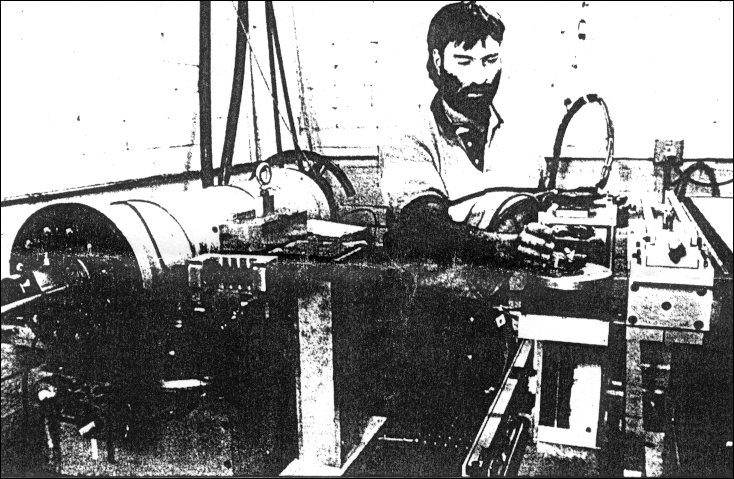
Staff photo by Mike Boroff
Brett Simon, senior tomographic technician at Sclentific Measurement Systems Inc., scans an automobile piston in a 420,000-volt scanner in the company's North Austin plant. The Image was computerized and then transmitted by phone to a laser device in UT's mechanical engineering building, where researchers there called their advanced 3-D prototyping technology a success.
World's First '3-D Fax'
UT researchers take rapid prototyping a step further
By Kirk Ladendorf
American-Statesman Staff
University of Texas researchers, only partly joking, called it the world's first 3-D fax.
By linking two high-tech systems - an X-ray scanning device and a computer-driven laser - the researchers this week transmitted a 3-D copy of an automobile piston over the telephone line.
They joined with Austin-based Scientific Measurement Systems, which makes high-tech industrial scanning devices, to put on the demonstration.
The automobile piston was scanned in Scientific Measurement's 420,000-volt scanner; the image was computerized and then transmitted by phone to a computer-driven laser device in the basement of UT's mechanical engineering building.
The result of the first trial was im-perfect, but it was rated a success. "It worked," said UT mechanical engineering Professor Joe Beaman. "I wouldn't call it a pretty part, but it was definitely it" - the auto piston reformed in polycarbonate material and scaled down to about one-third its original size.
The copied part did not include all of the detail of the actual piston, Beaman said, because only 60 scanned cross sections were made to save demonstration time.
The demonstration was conducted in conjunction with a UT-sponsored international symposium on advanced methods for solid free-form fabrication, or as it is more commonly called, rapid prototyping.
UT is considered a leader in the field. Out of its mechanical engineering laboratory came the process called laser sintering - using a computer-driven laser to fuse together fine powder of material into precise 3-D prototypes made of polycarbonate.
DTM Corp., an Austin-based startup owned by the B.F. Goodrich Co., has developed commercial versions of laser sintering devices targeted at industrial users.
For Scientific Measurement Systems Inc. the "3-D fax" could create important new marketing opportunities for its sophisticated scanning equipment, which performs the industrial version of a hospital CAT scan
See UT G2
UT researchers make gains in 3-D prototyping technology
on the human body. "I see it as being a significant impetus to cause our products to start to take on more interest," said Jerry Martin, the company's vice president of marketing. Potential users, he said, could be aerospace companies, automobile makers and even utility companies that need to replace worn parts in nuclear power plants where drawings no longer exist. Considerable interest in the process has come from Japanese manufacturers, Martin said. For Beaman, the graduate adviser to Carl Deckard, who discovered laser sintering, the demonstration was just one more step toward expanding the power of the new technology. Beaman is currently exploring techniques to produce aluminum 3-D copies using the sintering process. Rapid prototyping is attracting interest from manufacturers as a way to short-cut the time-consum-ing and expensive method of turning out one-of-a-kind prototypes in maghine shops. A small industrial part can take six months and cost as much as $60,000 to make, according to some experts. Laser sintering can accomplish the same task in a fraction of the time and cost. The demonstration was supported by the Texas Advanced Technology program, a state-backed effort to show potential commercial uses of technology.