4
Week of August 12, 1991
ON Campus
UT Austin engineers to attempt first manufacture of solid object by long-distance laser sintering
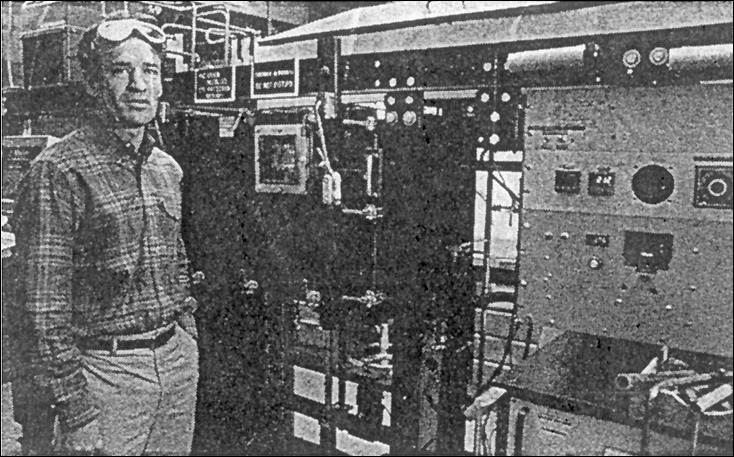
Photo by Larry Murphy
According to mechanical engineering professor Dr. Joe Beaman, "Laser sintering might be feasible for limited production of hundreds of the same object."
Photo by Larry Murphy
According to mechanical engineering professor Dr. Joe Beaman, "Laser sintering might be feasible for limited production of hundreds of the same object."
By Robert Tindol
Researchers at UT Austin will join with Scientific Measurement Systems Inc. this week in trying to create a solid, three-dimensional object by transmitting digital information by telephone to a laser device. If successful, the experiment will mark the first time that the process - known as laser sintering, a form of desktop manufacturing will have been employed in such a manner. In laser sintering, a design is converted by a computer into digital information, which in turn is used to guide a laser in fusing, or sintering, a powdered material to make a solid object. The process was invented by Dr. Carl R. Deckard, a former UT Austin me chanical engineering student, and is being commercialized by the Austin-based DTM Corp. Dr. Joe Beaman, who was Deckard's graduate adviser at UT Austin and who now conducts research on laser sintering, says the process is an important breakthrough in manufacturing because of the expense and time involved in machining a custom-designed part. Whereas a small metal part can take as much as six months and cost as much as $60,000 to make if it is a one-of-a-kind itern, laser sintering can accomplish the same task in a fraction of the time and cost. Most processes are associated with subtracting material, so the reason you have a lot of parts made is so you can put them to gether," Beaman says. "We're adding material one layer at a time, regardless of how complex the interior of the part is, and this means that you don't have to worry about how to get the milling tool inside to do intricate work. A part is often structured notonly for a function, but also to address the limitations of current machining technology, so laser sintering will allow a way around this. The real impetus these days is how fast you can get a product to market," Beaman says. "One reason for the Japanese success in automobiles is that they've reduced the time from market information concept to prototype to three years. It still takes American auto manufacturers five years to accomplish the same thing, but laser sintering could help us by allowing for faster prototypes." Laser sintering works by depositing a thin layer of powder on a flat plate level with the floor of an oven chamber and then rapidly passing a tiny but intense laser beam over selected areas of the powder. In effect, the powder on the plate becomes a thin slice of the final object, with the laser fusing the powder in any area where solid material is called for by the design. If there is to be a hollow space in an area of thatslice, the laser does not fire when passing over that area, leaving a layer of loose powder on the same plane as the fused material. Once a layer has been completed, the plate in the oven chamber drops slightly, another deposit of powder is spread evenly, and the laser is again passed over the entire area of the plate. The process is continued until the object is finished, and any pockets of loose powder are then blown away. The process is so delicate and precise that researchers have made what they describe as the first seamless toy whistle. In the traditional manufacturing process, two halves of a whistle are molded so that they can be glued together around a ball that rattles in the central chamber. In the laser sintering process, the ball is formed on top of a layer of powder as the entire whistle is built up, and when the object is finished, the solid ball is totally enclosed by powder inside the whistle's hollow chamber. The powder is then removed, leaving the ball to rattle free in the chamber. The original powder materials used for the laser sintering process have been polymers and investment casting wax. When the latter is used, the wax impression of the object is dipped in a ceramic slurry, which is then allowed to harden. Afterward, the wax is melted away and hot metal is poured into the ceramic shell to make the final product. In recent months, Beaman and his coworkers have experimented with sintering ceramic and metal materials. Sintering wax impressions requires only one tenth the time of the traditional lost-wax process, while making the object directly from metal with the sintering process requires only one hundredth the time of the traditional method. We first thought that maybe two or three identical objects would be the limit," says Beaman. "Now we're thinking that laser sintering might even be feasible for limited production of hundreds of the same object." Beaman says that the only limit to the materials that can be used in laser sintering is the ability of the material to soften during the sintering process. Nevertheless, the researchers have already found a wide variety of materials that work in the process. During the demonstration, to be conducted Aug. 13, Scientific Measurement Systems Inc. will transmit information by telephone on the dimensions of a jet turbine blade from the company's headquarters at 2209 Donley in North Austin to a lab in UT Austin's Engineering Teaching Center, where the mechanical engineering department and various research facilities are housed. Jerry Martin of Scientific Measurement Systems says the data to be transmitted will be obtained by an X-ray inspection process known as computed tomography, in which X-rays are used to measure both the external and internal dimensions of an object, regardless of the object's complexity. Data obtained as the turbine blade is being scanned with X-rays. will be transmitted by telephone to a laser sintering device on the UT Austin campus. If all goes well, a polymer reproduction of the turbine blade will be completed about an hour after Scientific Measurement Systems technicians begin transmitting the information across town. Scientific Measurement Systems Inc. is a leading supplier of computerized X-ray inspection systems for the aerospace, aircraft, automotive and defense industries.